Bob Penkhus Mazda at Powers - Which is better for mountain commutes around Monument, CO — 2026 Mazda CX-5 or 2026 Hyundai TUCSON?
One of the most common questions shoppers ask is straightforward: which compact SUV is the smarter pick for changing conditions and daily practicality in the Front Range? If you are comparing the 2026 Mazda CX-5 and the 2026 Hyundai TUCSON for commutes around Monument, CO, traction, technology, and daily livability quickly rise to the top. Both bring strong safety suites and modern comfort. Yet the CX-5 stands out with standard i-Activ AWD, a refined chassis that inspires confidence at speed, and an available 15.6-inch integrated touchscreen with Google built-in for native navigation and apps.
Because winter can arrive quickly along the Palmer Divide and afternoon storms can surprise even the best planners, traction-by-default matters. The CX-5 includes AWD on every trim, so you get the all-weather baseline without hunting options. Hyundai equips the TUCSON with available HTRAC AWD and Snow mode, which is genuinely helpful when chosen, but several shoppers prefer knowing their SUV is always ready for slushy parking lots or a last-minute drive up to Fox Run Regional Park. If you regularly commute between Monument and downtown or split time between neighborhood errands and I-25, standard AWD helps remove variables.
AWD philosophy: predictive vs. reactive
Mazda’s i-Activ AWD continually monitors inputs and can preemptively adjust torque when conditions suggest slip. Pair that with G-Vectoring Control, which subtly aids stability in transitions, and the result is a planted, calm feel that builds driver confidence. Hyundai’s HTRAC AWD is capable, sends power rearward as needed, and offers Snow mode among its drive settings. The difference is philosophical: the CX-5 aims to predict and smooth the experience, while the TUCSON prioritizes selectable modes and on-demand traction. Both approaches work, but many commuters prefer the way the Mazda just feels “sorted” across mixed conditions without extra thought.
Ground clearance, curb weight, and tire choice all play supporting roles in real-world grip. In either SUV, winter-rated all-season or dedicated winter tires will improve cold-weather performance. That said, the CX-5’s balanced chassis and standard AWD provide a consistent baseline, a benefit you can feel when descending a slick neighborhood hill or merging onto a wet highway.
Technology that truly helps day to day
The CX-5’s available 15.6-inch touchscreen delivers a cohesive, easy-to-learn interface. With Google built-in, you get native Google Maps with fresh traffic data and the Google Play catalog for compatible in-car apps. That means no fumbling with your phone or juggling different interfaces in poor weather. The CX-5 is also set to support Google Gemini in the vehicle in the future, allowing more natural voice interactions to keep hands on the wheel. TUCSON’s hybrid display setup is modern and offers smartphone integration, but it does not offer native Google apps at the system level. For commuters who rely on live navigation and consistent voice assistance, the CX-5’s integrated approach is a meaningful advantage.
Camera tech helps too. Both SUVs offer a surround-view system that makes crowded lots around grocery stores or park trailheads less stressful. The difference comes back to integration and tuning: Mazda’s clean interface design, high seat comfort, and low cabin noise make those daily touchpoints feel more premium and less fatiguing across a week of commuting.
Ride and refinement on the Front Range
Mazda’s recalibrated 2.5-liter SkyActiv-G and 6-speed automatic focus on smooth, predictable response. The tuning feels transparent: steady on highway grades, unbothered by crosswinds, and poised through sweeping ramps. Hyundai’s 2.5-liter four-cylinder with its transmission is likewise competent, and when paired with HTRAC AWD it makes for a confident package. Still, the CX-5’s steering weight and throttle mapping contribute to a sense of unity you notice every time the road bends or the weather turns.
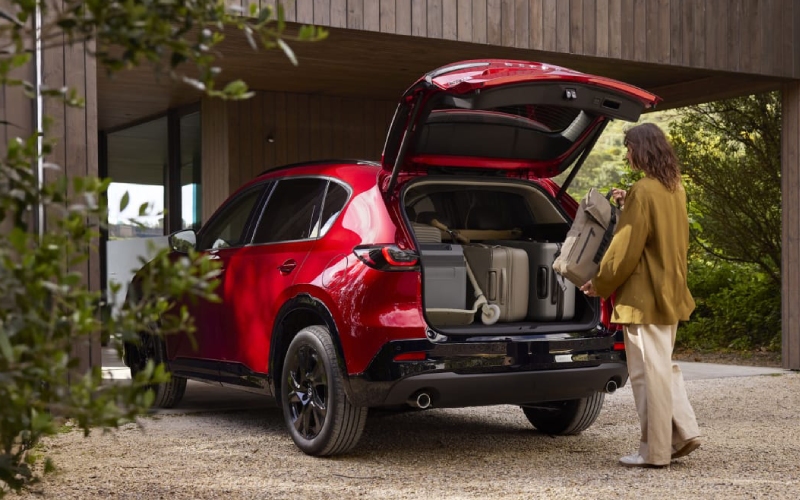
Cabin practicality plays into refinement, too. The CX-5’s larger door openings simplify loading kids and gear; the longer, taller cargo area with a lower lift-in height makes it easier to swing in a cooler or frame pack. TUCSON counters with flexible storage solutions of its own, including split-fold seats and a low liftover, so either will handle weekend errands. The edge for the Mazda is how the gains in space come packaged with an interior that feels deliberately uncluttered and serene, with available ambient lighting that keeps night drives relaxed.
Who should choose which?
- If you want AWD standard: The CX-5 removes guesswork by including i-Activ AWD across the board.
- If you value native Google apps: CX-5’s Google built-in brings Maps and Google Play right to the dash, with Google Gemini support on the horizon.
- If you prefer selectable drive modes: TUCSON’s Snow and other modes in HTRAC AWD offer user-driven control once you’ve added AWD.
Beyond the spec sheet, consider your routes. Do you regularly climb or descend through changing temperatures, or park on sloped neighborhood streets after a storm? The CX-5’s predictive AWD personality can reduce mid-commute surprises. Do you prize a unique exterior design and like to tailor modes to the day? A TUCSON with HTRAC AWD can be a rewarding match.
Frequently Asked Questions:
Is AWD really necessary for Monument-area commuting?
No vehicle can replace good tires and attentive driving, but standard AWD in the CX-5 delivers consistent traction for shoulder-season days and quick squalls. If you frequently drive early or late when roads are colder, AWD can be the difference between confidence and caution.
Does native Google Maps add more than smartphone mirroring?
Yes. Native Maps integrates deep vehicle controls and live data without juggling phones or cables. It’s faster to boot, more stable in poor connectivity, and supports voice features that keep your focus on the road.
Will TUCSON’s Snow mode match the CX-5 in winter?
Equipped with HTRAC AWD and appropriate tires, TUCSON is very capable. The CX-5’s advantage is that its AWD logic is always working, and its handling calibration encourages calm, stable inputs on slick pavement.
Where can I test both setups on the same roads?
You can compare the feel of standard AWD and interface design on your everyday routes and decide which suits your habits best. It’s the surest way to sense differences in traction behavior, ride composure, and in-cabin tech flow.
Ready to put theory into practice? Plan a route that includes neighborhood streets, a stretch of I-25, and a few stop-and-go segments to gauge throttle and brake feel. That variety will highlight the CX-5’s planted character and user-friendly tech. Visit Bob Penkhus Mazda at Powers for a focused drive and practical walk-through of the features that matter most when conditions change quickly. Our team is serving Castle Rock, Monument, and Centennial with guidance tailored to the roads you drive every day.